Creator Tools · Virtual Idol
From Static Art to
From Static Art to
Live Virtual Idol.

Context
5+ days just to get started.
Most creators dropped out before going live.
Within the same creator supply initiative at AcFun, I identified a second bottleneck: virtual idol streaming was fast-growing, but getting started required hiring a rigging artist — a process taking 5+ days and costing up to ¥3,000.
Most independent creators dropped out before they ever went live.
My Role
Cross-team scope:
I co-led this project with a senior PM. The strategic framing — that reducing production barriers was the most scalable supply-growth lever — was a direction I actively contributed to. My focus was execution: feature specification and cross-team coordination across engineering, design, and an algorithm team from another department.
As an ACG community member myself, I had native intuition for the audience. The gap I had to bridge was technical: building enough fluency with our algorithm and design constraints to make informed product decisions, even outside my core domain.
What We Built
Three pillars:
Users upload a structured PSD file; the software automatically handles rigging at no cost, then drives the virtual character in real time via webcam.
We also provided official PSD templates and tutorials to lower the learning curve. The tool additionally supported importing existing Live2D and VRM model formats for creators who already had professional models.
The Harder Problem
"What looks right" lives in the community, not in training data.
— Aesthetic Calibration
The real challenge was aesthetic calibration. Our algorithm could optimize motion capture accuracy — but it couldn't judge what looked right within ACG visual culture.
It required constant iteration between our designer and algorithm team, and it's a problem that remains unsolved even with today's AI.
The Result
Setup Time
Rigging cost cut by up to 90%, replaced by a one-time investment in learning the PSD spec — which we actively reduced through templates and documentation.
Selected Artifacts
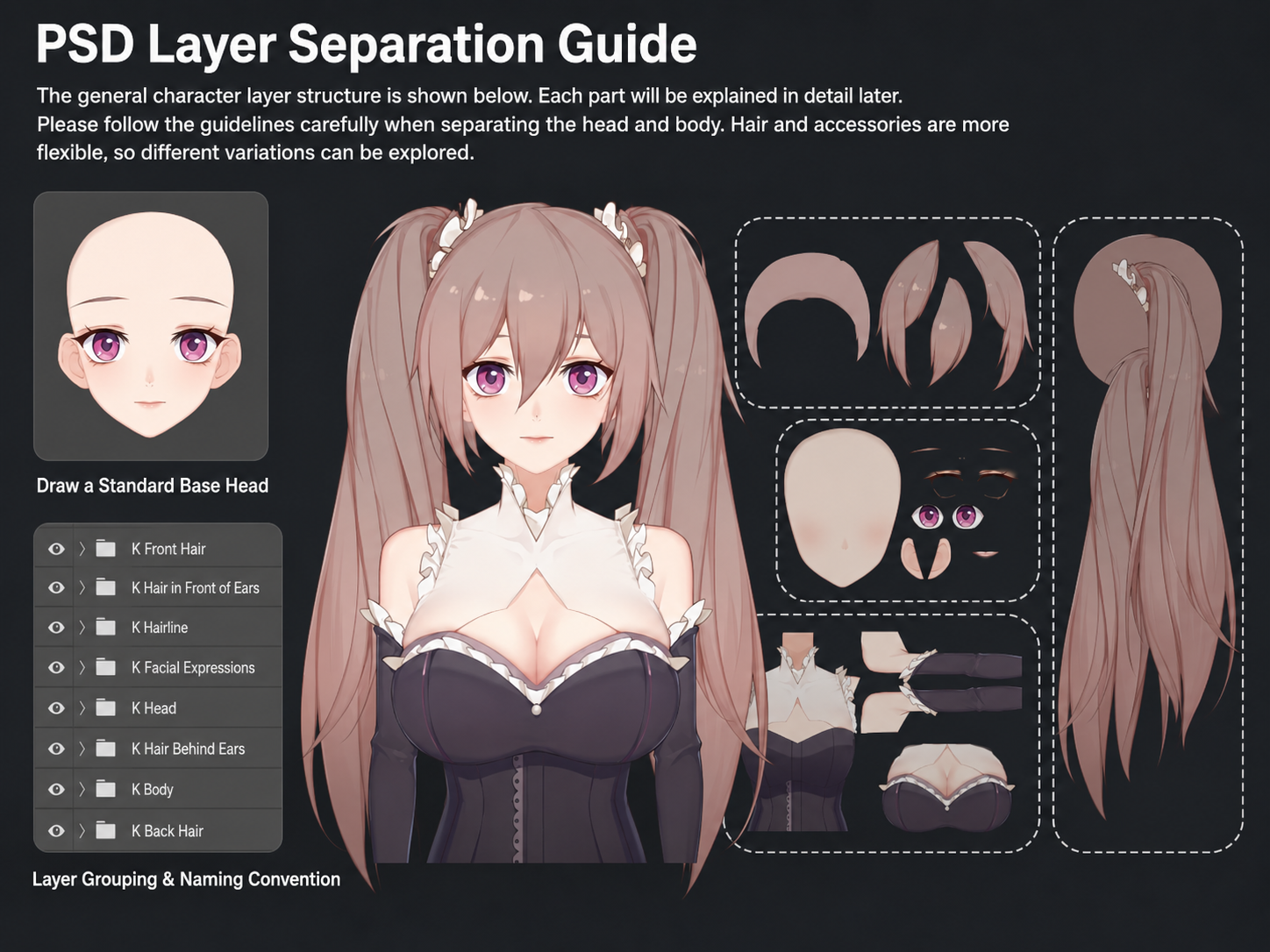
PSD Splitting Specification
Face Capture in Action