Infrastructure · Internal Tooling
Rebuilding Push
Rebuilding Push
from the Ground Up.
Context
"What's the delivery rate of friend push notifications?"
— No one could answer.
While building a friends feature on Baidu Netdisk, I ran into a simple question: what's the delivery rate of friend-related push notifications? No one could answer it.
When I dug deeper with engineering, the picture was worse than expected. We had no funnel visibility, and our push infrastructure had fallen into disrepair — built on a shared internal system that another department had stopped maintaining.
The problem wasn't just the friends feature. The entire company's push capability was broken.
My Role
Scope of work:
I was the sole PM on this project. Rather than patching the existing system, I scoped a full infrastructure rebuild: integrating a third-party push provider for Android, and working with engineering on an in-house solution for iOS.
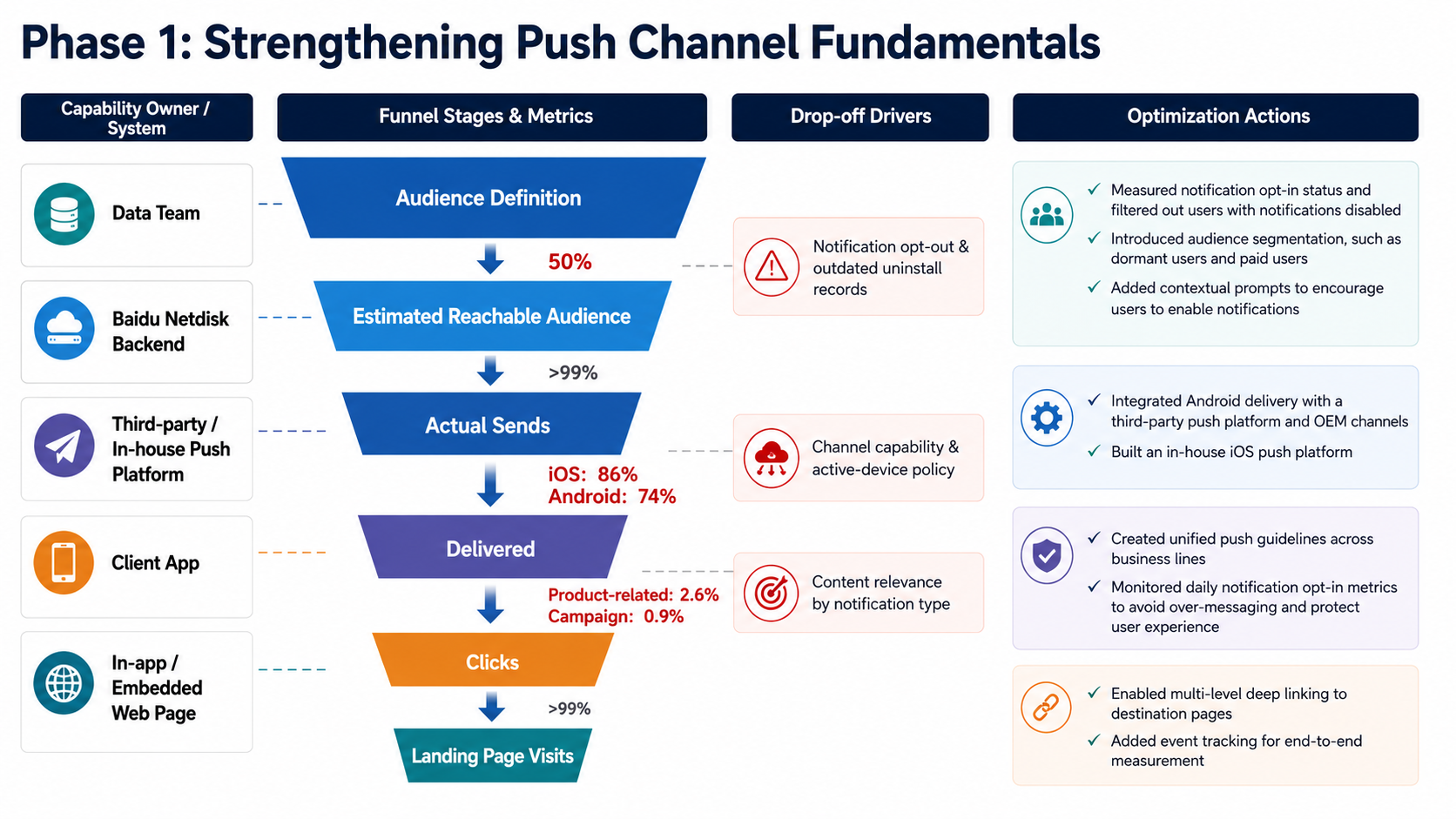
I also defined the requirements for an end-to-end delivery funnel so we could finally see where notifications were dropping off, from send to open.
What We Built
Console features:
The rebuilt infrastructure restored reliable delivery across both platforms with full funnel observability — every step from send to delivery to open was now tracked.
On top of the infrastructure, I built a self-serve push operations console for internal teams across the company. Product teams used it for feature-driven notifications like photo memories and on-this-day prompts. Growth and marketing teams used it for membership offers and campaign pushes.
The console included configurable targeting, scheduling, frequency caps, abuse monitoring, and user opt-out controls — enough governance to let multiple teams operate independently without degrading the user experience.
The Result
Delivery Reliability Restored
End-to-end funnel observability introduced for the first time, eliminating routing blind spots and enabling teams across the company to operate push independently.
Selected Artifacts
Phase 1 · Delivery Funnel

Phase 2 · Push Ops Console